Gratitude and reciprocity are the currency of a gift economy, and they have the remarkable property of multiplying with every exchange, their energy concentrating as they pass from hand to hand, a truly renewable resource.
— Robin Wall Kimmerer, The Serviceberry
Context
And Also Too is in the pilot year of the Design Justice Practice Circle. We have developed and presented two workshops — Creative Practice in a Time of Upheaval (virtual) and Designing the Post Internet (in-person).
We love presenting workshops where people can learn new skills and frameworks and nerd out together. But, in gathering around these themes of collapse, we sensed a deeper need. People engaged with Design Justice right now (whether they have the word “designer” in their job title, or if they draw on design practices and the Design Justice Principles in their organizing or day to day work) need tending to.
They — and us at And Also Too — are in need of creative spaces of belonging and sustained conversations about what it means to be designing in this moment in history. They are seeking deeper relationships to support them in doing work that is meaningful to them. And they are looking at their toolboxes. Which tools need sharpening? Which ones are just taking up space and making the others dull? And what tools might be borrowed and adapted from elsewhere that would breathe new life into their practices?
To this end, we’re testing out a new offering called Constellations. Our first Constellation is a group of 7 people who have engaged with at least one of our offerings in the past. Our first set of practices involved one on reciprocity. We owe deep gratitude to Robin Wall Kimmerer for her writing, and to Indigenous peoples of the lands we live on, for keeping these teachings alive and sharing them with profound generosity.
We had a rich — yet too short — conversation on integrating an orientation towards reciprocity into our design practices. Here are some reflections after taking the time to digest everyone’s thoughts.
A learned practice
Our oldest teaching stories remind us that failure to show gratitude dishonors the gift and brings serious consequences. If you dishonor the Beavers by taking too many they will leave. If you waste the Corn, you’ll go hungry.
— Robin Wall Kimmerer
Those of us who already had an intentional orientation towards reciprocity could identify where that learning had come from, whether it was from our upbringing, community (spiritual/cultural/political), or the natural world.
Capitalist and colonial logic attempts to drown out these lessons with loud signals to hoard, gain status, and treat every relationship as a transaction. It’s why so many of us — even those steeped in teachings of reciprocity — found ourselves veering into transactional thinking when doing our practice work. How to make good with those who have supported our careers? How to repay the communities I earn my living from? (These are not actual statements from the group, though they are in the spirit of the conversation.)
Worthiness
Transactional thinking leads to questions of worthiness. How can I possibly account for all the gifts that allow me to do the work I do? How to, for example, repay my ancestors for my talents, the people who inspire me, the communities that make my work possible, and the earth which provides the raw material or energy for the things we make and set in motion?
The truth is, it’s not possible. We’re all small parts of an enormous and intricately connected web of creation. There are an innumerable number of things that had to be made, to exist, and to die for us to walk with the gifts we hold. A single perilla seed I planted in the spring, with a small amount of care and attention, gave me hundreds of perilla leaves, then died, and in so doing, gave me thousands of seeds. Allowing the immense gratitude for it all to wash over me releases me from the idea that I need to earn my worthiness of these gifts.
As people — designers, makers, engineers, organizers — who have taken up the work of creating the world we live in, where do we see ourselves in this web? What responsibilities do we bear for the things we put into the world?
Big and small

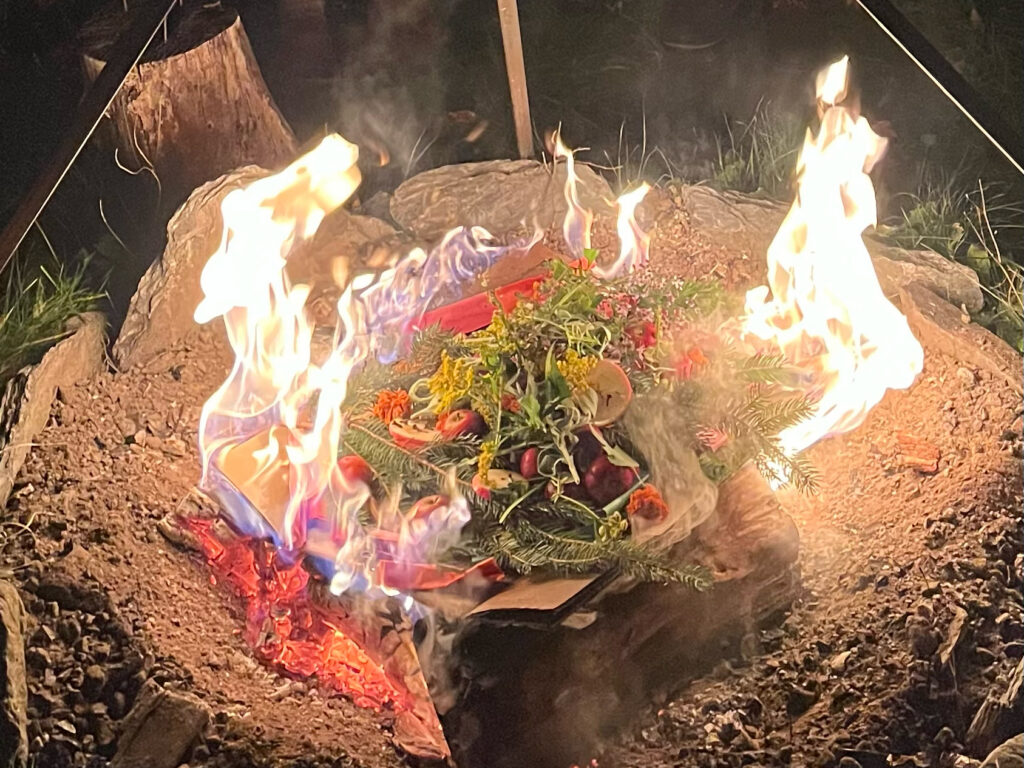
Some reciprocity practices are big. We talked about spaces and events we organize. The first photo in this post is from a ceremony that closed an event which took a significant amount of effort to organize. And we acknowledged that this scale of practice is not within reach for everyone.
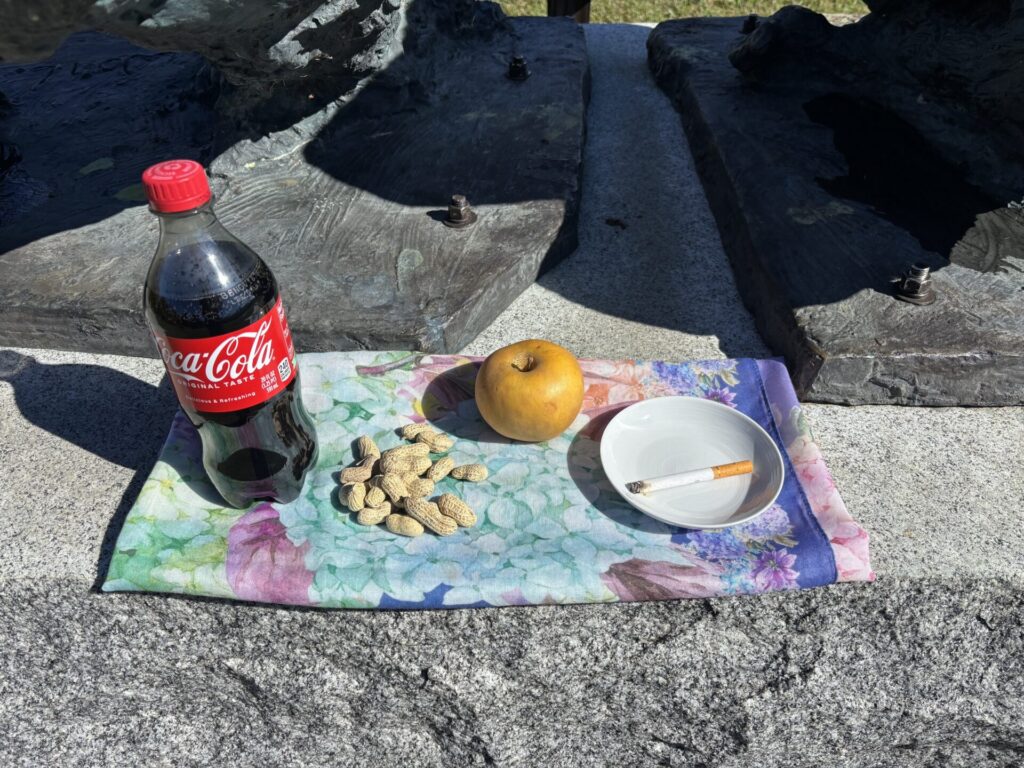
Some practices are small and medium. Setting out peanuts for the crows. Showing up for an event someone has invited you to. Saying yes to a request from a young designer to pick your brain.
What we might notice
Some things we might notice when we re-orient ourselves towards reciprocity in our design practice and our lives:
- All the generosity you are already putting into the world, and all the generosity that is coming towards you
- Feeling less alone, because you see how interconnected your existence is with everything else that exists
- A swelling urge to resist things and experiences that produce lifelessness and separation
- A desire to fill what we are making with life, and to use what we make to strengthen connection
- An expansive sense of the kinds of solidarity that are possible, because we are moved by our sense of connectedness rather than guilt, shame, or a sense of indebtedness
- A feeling of certainty about using our creative energy — the thing that makes life in this world — in service of something much greater than ourselves